
"Japan will participate in MALABAR this year which is our largest bilateral naval exercise with India and it's scheduled to take place at the end of this month," Deputy Assistant Secretary of Defense for South and Southeast Asia Amy Searight told lawmakers during a Congressional hearing on Thursday.

China's South China Sea build-up and 'territorial sea' construct potentially affects 55 percent of Indian trade passing through the region. Hence, coordinating with the US and Japan could provide dividends to India in the longer run,' says Srikanth Kondapalli.
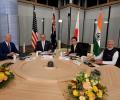
Saturday's Quad meeting in Delaware is taking place against the backdrop of China's assertive behaviour in the South China Sea, its sabre-rattling in the Taiwan Strait and increasing footprints in the Pacific and Indian Ocean, asserts Rup Narayan Das.

Indian policymakers must realise that in buying small quantities of equipment, it becomes hard to start manufacturing them in India, explains Ajai Shukla.


Reports (not denied by India) that the USA had 'for the first time provided real-time details to their Indian counterparts on the Chinese positions and force strength in advance of a PLA incursion' into Tawang at the LAC in December 2022, helping India thwart China's expansionist designs, show how operationally effective the USA-India friendship has become on the ground. A engaging excerpt from Sreeram Chaulia's must-read new book, Friends: India's Closest Strategic Partners.
Notwithstanding fears of a tsunami following a powerful earthquake off Indonesia on Wednesday, the navies of India and the United States carried out their joint exercises off the coast of Chennai.
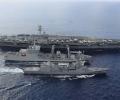
It was for the first time that a Chinese spy ship was detected in Japanese water since a submarine was spotted in 2004. The latest intrusion came less than a week after another Chinese naval vessel sailed near islands at the centre of a Tokyo-Beijing sovereignty dispute in the East China Sea.
For the first time, the US Navy will include long-range maritime and submarine hunter aircraft P3C Orions in the exercises.
Th defence minister said warships of the two countries conducted seven exercises, involving participation of two US nuclear carriers and five nuclear-powered submarines in the Malabar series of war games.
Two US warships and a nuclear submarine will join the 'Malabar' series of exercises along with Indian Navy frigates and a German-made 'Shishumar' class HDW submarine.
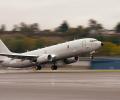
The P-8I, which is widely acknowledged to be the world's most deadly LRMR-ASW aircraft, is a derivative of the Boeing 737-800 airliner, onto which a plethora of sensors and weaponry has been fitted.
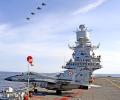
There is concern about the poor state of readiness of the navy's 140 warships which face severe shortages in sonar equipment, helicopters and torpedoes.

'The focus on countering terrorism brings to the issue Beijing's non-serious approach in this regard. India's permanent representative at the UN has raised in vain the issue of funding and the release of 26/11 suspect Zaki-ur Rehman Lakhvi. But China has blocked these objections since December 2014 at the UN even after 'highest levels' in India intervened,' notes Srikanth Kondapalli, reviewing the India-China military exercises in Kunming.

The compulsion behind India and Japan to deepen security cooperation is in response to China's growing political and economic clout and its assertive behaviour in disputed areas. This has been the key driver for bringing both India and Japan closer in the domain of security cooperation, explains Dr Rajaram Panda.

You will appreciate the Mammootty of this movie better if you do not take the servile reviews to heart, for this is a grand, broad, almost proudly comic performance, assures Sreehari Nair.

"Whatever we are doing is in close coordination and synergy with the army and the Indian Air Force to produce desired results," he said.

That Australia is ready for a substantive engagement is evident from its 2013 Defence White Paper, which emphasised the need to build stronger defence relations with India, says Ajai Shukla

India is no longer shying away from playing a role on the regional and international stages and is willing to don a bigger role in regional politics. It is showing traits of a responsible stakeholder in the regional security dynamics, says Dr Rahul Mishra.
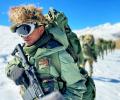
The United States will continue to support India with equipment and other things it needs along the Line of Actual Control (LAC) with China, a top American admiral has told lawmakers, asserting that Washington and New Delhi share a 'tremendous partnership'.

With the situation in Ladakh tense and no resolution in sight the trigger to take the India-US relationship to a transformational one is already there, observes Lieutenant General Syed Ata Hasnain (retd).

Morrison said ways to deepen bilateral trade and investment ties and harness new economic opportunities to support mutual economic recovery and growth will also be discussed at the summit.

India and Japan on Thursday agreed to enhance military exercises and defence cooperation as the two countries emphasised that the bilateral special strategic and global partnership plays a crucial role in ensuring a free, open and rules-based Indo-Pacific, amidst China's aggressive behaviour in the region.

India is increasingly a willing participant in the evolving US' Indo-Pacific strategy. While these developments are related to the perception of a growing Chinese security challenge, their implications for India's much-vaunted strategic autonomy should be a matter of deeper and closer reflection, asserts former foreign secretary Shyam Saran.

The India-Japan joint naval exercises are a strategic signal for China, observes Dr Rajaram Panda.

"We value our partnership with India, and we've been increasing it and doing a lot more, over time. They have the same security challenge, primary security challenger that we do, and it's real on their northern border," Admiral John Christopher Aquilino, commander of United States Indo-Pacific Command, told members of the House Armed Services Committee during a hearing on Indo-Pacific National Security Challenges.

As Japan beefs up its defences against China, both New Delhi and Tokyo seem to have decided to re-energise their relationship to ensure a strategic balance in Asia. It is a clear signal that they may be ready to work together in containing if not confronting China, says Nitin Gokhale.

They said all personnel on board the warship were safe.

The navy has deployed surveillance aircraft and ships to locate the missing pilot.
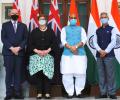
India and Australia on Saturday decided to expand military engagements across services and facilitate greater sharing of critical information in line with their resolve to significantly expand strategic ties.
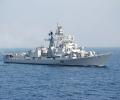
The Indian ships' participation in MALABAR-16, a maritime exercise with the US Navy and Japan Maritime Self-Defense Force, reflects the vital strategic importance of the region to India.
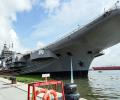
In New Delhi's corridors of power, debate continues on whether the navy even needs a third aircraft carrier.
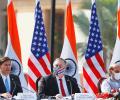
China is now the most significant strategic concern in Washington, as in most of the world's capitals, especially the democracies. Today, strategic autonomy has acquired a sharper definition: To ward off the Chinese challenge to India's territorial integrity, sovereignty and regional stature, observes Shekhar Gupta.

'It will be a repeated folly to ever think that China will not attack us.'

Admiral Sam Locklear heads the US Pacific Command, making him the most powerful military commander on earth. With 60 per cent of the US Navy under him, PACOM oversees 52 per cent of the planet. Locklear is America's military pointsman for 36 countries, including India and China.

'It was almost as though there was widespread relief that the defence bureaucracy, and the minister, could find someone willing to shoulder the blame for everything that had gone wrong with the services under Antony's charge -- the poor preparedness of the forces, slow acquisitions caused by indecision, cancellation of contracts and whimsical blacklisting of defence contractors over the tiniest suspicion that they may have paid speed money or kickbacks.'
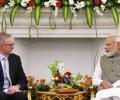
The matter came up for discussion during their wide-ranging dialogue that was aimed at expanding overall ties.

India is playing its South China Sea card by restarting oil exploration off Vietnam coast despite China's objections as a calculated geopolitical move to force Beijing to make "compromises" on border issue and its close ties with Pakistan, a state-run Chinese think-tank has said.

The Indian Navy's flagship carrier, the INS Viraat will be decommissioned on March 6 after serving the nation for 30 glorious years.
 © 2026 Rediff.com - Advertise with us - Disclaimer - Privacy Policy - Sitemap - Feedback - About us - Terms of use - Grievances